In this Appendix, we highlight an example calculation for the \(Z+1j\) process at NNLO. The full runcard is provided below, implementing the following items:
• In the
PROCESS
block, we specify the process (\(\mathrm {Z}\)-boson plus one jet) and the collider (proton–proton collider at \(\sqrt {s} = 7\,\mathrm {TeV}\). We further specify the jet algorithm used to reconstruct jets (anti-\(k_t\) with \(R = 0.4\)). See
Sect. 5.3.1.
• In the
RUN
block, we specify the PDF set, here NNPDF3.1. Additionally, we indicate a value for the technical cutoff (equal to the default \(t_\mathrm {cut} = 10^{-8}\)) and we turn on the multi-channel adapatation over individual channels (in this case, channels will be
grouped such that every phase-space point will evaluate a subset of 5 channels). See Sect. 5.3.2.
• In the
PARAMETERS
block, we select the \(G_\mu \) scheme and set the values for the masses and widths of the \(\mathrm {Z}\) and \(\mathrm {W}\) bosons and for the Fermi constant \(G_F\). See Sect. 5.3.3.
• In the
SELECTORS
block, we define the fiducial phase space for the selection of events. In particular, we require leptons to have \(p_{\mathrm {T}} > 20\,\mathrm {GeV}\) and \(|y| < 2.5\). Moreover, their angular distance in the rapidity–azimuth plane should be
\(\Delta R_{{\ell }{\ell }} > 0.2\) and they should feature an invariant mass \(m_{{\ell }{\ell }} \in [66,116]\,\mathrm {GeV}\). Jets are required to have \(p_{\mathrm {T}} > 30\,\mathrm {GeV}\) and \(|y| < 4.4\),
with \(\Delta R_{{\ell } j} > 0.5\). See Sect. 5.3.4.
• In the
HISTOGRAMS
block, we declare some histograms, such as the transverse momentum or the absolute rapidity of the leading-\(p_{\mathrm {T}}\) jet. Note in particular some features like: the possibility of specifying uniformly-spaced bins or declaring them with a custom list; the
file-name override (ptj1>ptj1_exc) to avoid name clashes when saving histograms; the histogram selectors to generate multi-differential distributions (e.g. we fill the
ptz_y1
histogram with the transverse momentum of the \(\mathrm {Z}\)-boson only when \(0.5 < |y_{Z}| < 1.0\)). See Sect. 5.3.5.
• In the
SCALES
block, we specify the set of renormalization and factorization scales to be registered for the calculation: we adopt \(\mu _R = \mu _F = \frac {1}{2} H_T\) (with \(H_T\) the scalar-\(p_{\mathrm {T}}\) sum over leptons and jets) as central scale and we
further compute six additional combinations of \(\mu _R\) and \(\mu _F\) according to the usual 7-point scale variation prescription to estimate theory uncertanties. See Sect. 5.3.6.
• The
CHANNELS
block is left empty as it will be automatically populated by the workflow described in Sect. 6.1. See Sect. 5.3.7.
The above runcard can be used as input to the job-submission workflow described in Sect. 6.1. After a run on the CERN lxplus submission system with a total runtime of order 50k CPU hours, one
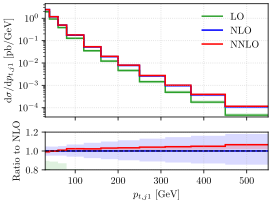
obtains a value of \(68.5(2)\) pb for the total NNLO fiducial cross section. Figure 2 shows an example of a differential distribution, namely the transverse momentum of the leading jet. The runcard with
all generated data files and plots are included as ancillary files to this publication.
Figure 2: Differential distributions at LO, NLO, and NNLO for the transverse momentum of the leading jet in \(Z+1j\). The uncertainty bands represent the envelope of a 7-point scale variation.